
Home >> PURE MATHS, Vectors, vector equations
first principles |
Component Rules
Consider two vectors in three dimensional space.
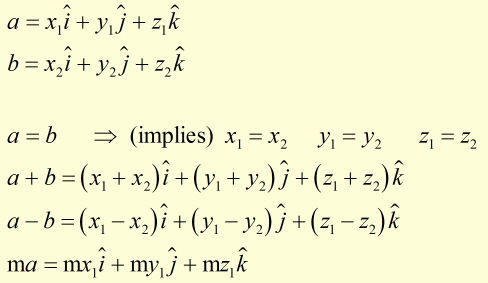
Where 'm' is a scalar quantity.
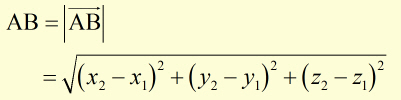
Hence, the magnitudes of a and b are given by:

In 3D space, if point A has position vector a and point B has position vector b then the distance AB is given by:
Equation of a Straight Line - single point & parallel vector given
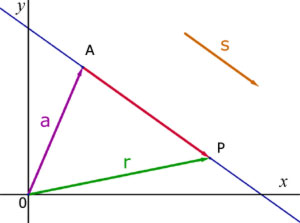
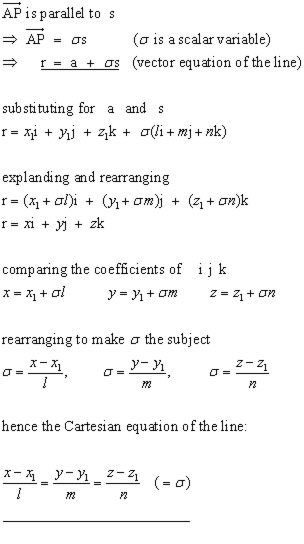
A(x1 y1 z1) is a fixed point on the line.
a is the position vector for point A a = x1i + y1 j+ z1k
s is a vector parallel to the line s = l i + m j+ n k
(l m n are called the direction ratios of the line)
r is the position vector for an arbitrary point P(x, y, z) on the line.
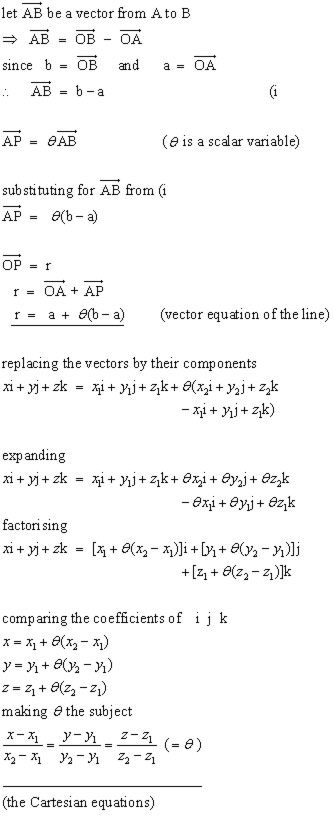
Equation of a Straight Line - two points given
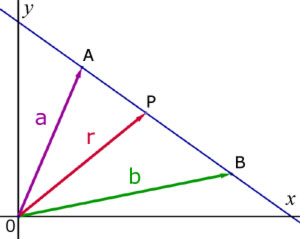
A(x1 y1 z1) is a fixed point on the line
a is the position vector for point A a = x1i + y1 j+ z1k
B(x2 y2 z2) is a fixed point on the line
b is the position vector for point B b = x2i + y2 j+ z2k
r is the position vector for an arbitrary point P(x, y, z) on the line.
[ About ] [ FAQ ] [ Links ] [ Terms & Conditions ] [ Privacy ] [ Site Map ] [ Contact ]