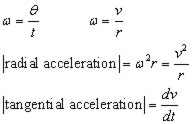
,
2D Motion : Circular Motion
 

[ position vector ][ velocity][ acceleration][ vertical circle ]


  • a drop-down menu of resources for 'empty.'
  • Summary of equations


    Describing the circle - position vector R
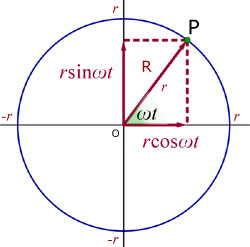
    circle position vector R

    i & j are unit vectors along the x and y-axis respectively.

    The position vector R of a particle at P from O, at time t, is given by:

    circle - position vector equationo

    As the position vector R rotates anti-clockwise, the particle at P traces out a circle of radius r .


    back to top


    The velocity vector V

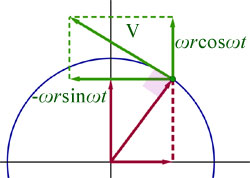
    The velocity vector V at an instant is given by differentiating the position vector R with respect to t .

    Here the unit vectors i & j, parallel to the x and y-axes, are centred on the particle at P.
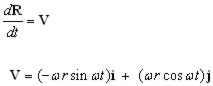
    vector equation for velocity

    circle vector V

    the magnitude of the velocity is given by:
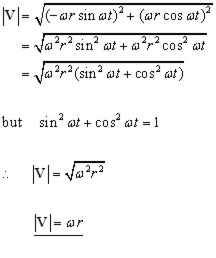
    circle velocity equation

    back to top

    The acceleration vector A

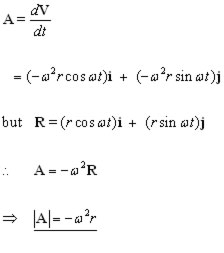
    The acceleration of the particle at P is given by differentiating V with respect to t .
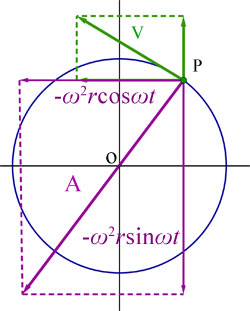
    circle - the acceleration vector

    circle - equation for acceleration

    Example

    A satellite is moving at 2000 ms-1 in a circular orbit around a distant moon.
    If the radius of the circle followed by the satellite is 1000 km, find:
    i) the acceleration of the satellite
    ii) the time for the satellite to complete one full orbit of the moon in minutes(2d.p.).
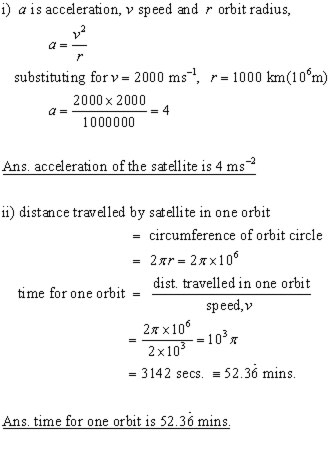
    circle problem#01

    back to top

    Non-uniform circular motion(vertical circle)

    A more in-depth treatment of motion in a vertical circle is to be found in 'kinetics/more circular motion'.

    Here we look at the more general case of the acceleration component along the circle and the component towards the centre varying.
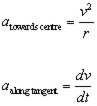
    circle - non-uniform acceleration

    Example

    A particle starts to move in a circular direction with an angular speed of 5 rad s-1 .
    The radius of the circle of motion is 4 m, and the angular speed at time t is given by,

    circle - non-uniform acceleration problem #01

    What is,

    i) the linear speed of the particle 6 secs. after it starts moving?

    ii) the resultant particle acceleration?

    (answers to 1 d.p.)
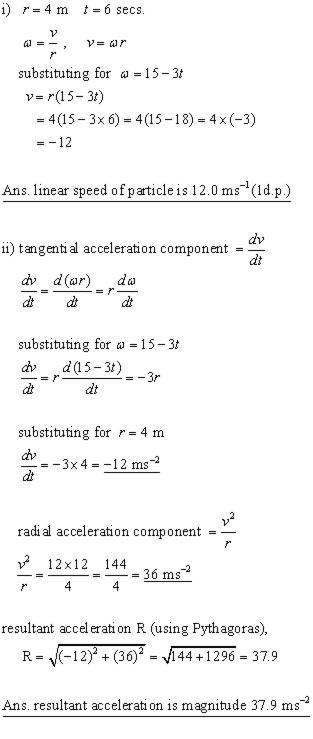
    circle - non-uniform acceleration problem #01b


    back to top


    science 1701
    NEW BLOG & PODCAST
    to boldly go where science
    & maths may take us

    [ PURE MATHS ][ MECHANICS ][ STATISTICS ]

    TOPIC NOTES(.pdf)

     
    uniform acceleration
    non-uniform accln.
    simple harmonic motion
    projectiles
    circular motion
    relative motion
    Newton's Laws
    connected particles
    work & energy
    power & efficiency
    more circular motion
    elastic strings
    impulse
    conservation momtm
    coeff. restitution
    part. forces in equilib.
    friction
    rigid bodies
    MORE...
     

    VIDEO


    INTERACTIVE


    EXAM PAPERS(.pdf)


        A-level Physics
        Tutor

        a FREE higher
        physics revision
        resource