
Home >> PURE MATHS, Differential Calculus, the derivative formula
first principles |
First Principles
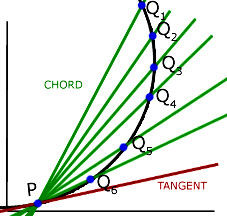
To find an expression for the gradient of the tangent at point P on a curve, we must consider lines passing through P and cutting the curve at points Q1 Q2 Q3 Q4 Q5 Q6 ...etc.
As Q approaches P so the gradient of the chord PQ approaches the gradient of the tangent at P.
We can form an expression for the gradient at P by using this concept.
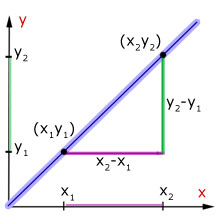
We know from coordinate geometry that:
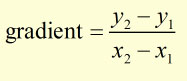
for points (x1y1) and (x2y2)
Consider the coordinates of P to be (x,y) and point Q to be (x+dx, y+dy), where dx and dy are the horizontal and vertical components of the line PQ.
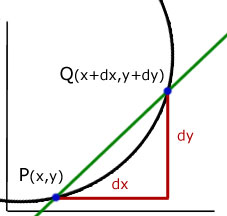
Gradient of the line between points (x,y) and (x+dx, y+dy) is given by :

The tangent to the curve = gradient of PQ when the length of PQ is zero and dx = 0 and dy = 0.
In the limit, as dx 'approaches zero' the gradient of the curve is said to be dy/dx.
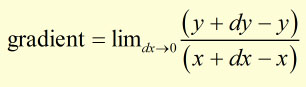
Since,
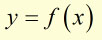
if we incrementally increase both y and x , then
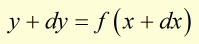
Now we can substitute for y + dy in the top bracket of the 'gradient' equation.
At the same time we can replace the y by f(x) .
In the bottom brackets the +x and the -x cancel out, leaving dx
Then we have:

that is,
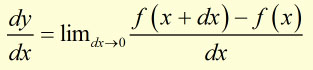
Example: Find the gradient of y = 4x2.
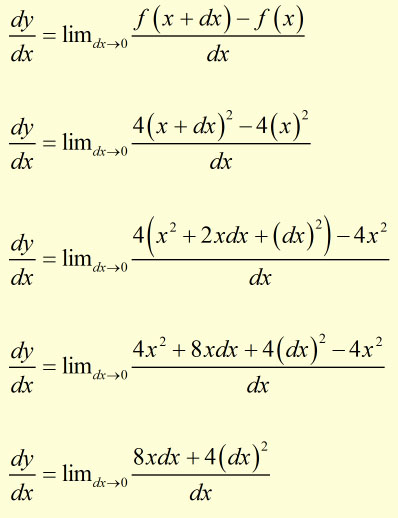
cancelling by dx,
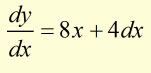
in the limit when dx = 0 this becomes,

Without doubt this is a very long winded way to work out gradients. There is a simpler way, by using the Derivative Formula.
Notation This is best described with an example.
If y = 3x2 , which can also be expressed as f(x)= 3x2, thenthe derivative of y with respect to x can be expressed as:

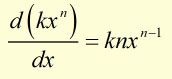
The Derivation Formula
If we have a function of the type y = k x n , where k is a
constant, then,
example #1
Find the gradient to the curve y = 5 x2 at the point (2,1).
gradient = (5) (2 x2-1) = 10 x1 = 10 x
gradient at point (2,1) is 10 x 2 = 20
[ About ] [ FAQ ] [ Links ] [ Terms & Conditions ] [ Privacy ] [ Site Map ] [ Contact ]