,
Statics : Friction
 

[ the laws of friction ][ the angle of friction]


  • a drop-down menu of resources for 'empty.'
  • Friction is the force that opposes movement.
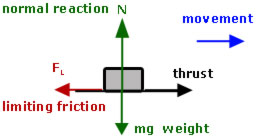
    limiting friction

    The 3 Laws of Friction

    1.

    The limiting frictional force ( FL )is directly proportional to the normal contact force ( N )

    limiting friction proportional to normal reaction

    note: limiting frictional force is the maximum frictional force

    2.

    The ratio of the limiting frictional force ( FL ) to the normal contact force ( N ) is called the coefficient of friction (μ )

    coefficient of friction

    3.

    When there is no motion, but the object is on the point of moving,

    applied force = frictional force(limiting friction)

    and when there is motion,

    applied force > frictional force(limiting friction)

    then this equality applies:

    FL = μ N

    Up to this point, when the frictional force is less than limiting friction(maximum)*, then the inequality below applies.

    FL< μ N

    *object is static and not on the point of moving

    Example #1

    A flat stone is thrown horizontally across a frozen lake.
    If the stone decelerates at 2.5 ms-2 , what is the coefficient of friction between the stone and the ice? (take g=10 ms-2)
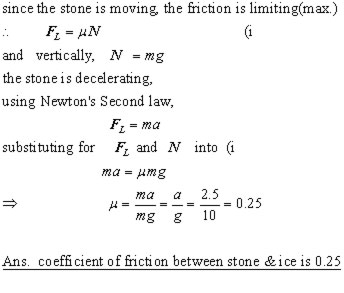
    friction prob #01

    Example #2

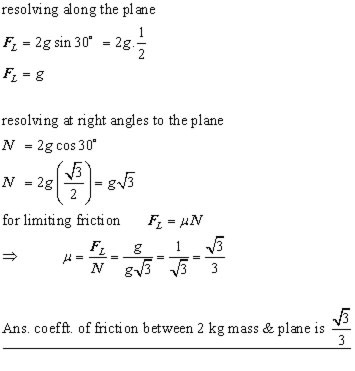
    A 2 kg mass in limiting equilibrium rests on a rough plane inclined at an angle of 30 deg. to the horizontal.
    Show that the coefficient of friction between the mass and the plane is √3 / 3 .
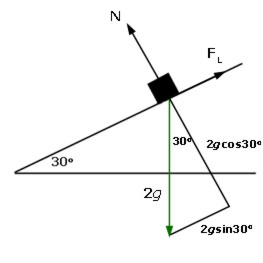
    inclined plane friction problem

    friction prob #2

    back to top


    The Angle of Friction

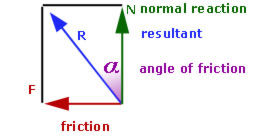
    angle of friction

    If we examine the normal reaction force( N ) and the frictional force( FL ) when it is limiting, then the equation FL = μ N applies.

    If the resultant between N and FL is R , and it is inclined at an angle α(alpha) to the normal N, then we can write equations for FL and N in terms of R .
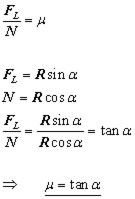
    angle of friction

    In example #2(above) the angle of friction = tan -1(√3 / 3)
    = tan -1(0.5773) = 30o (the angle of the plane)


    back to top


    science 1701
    NEW BLOG & PODCAST
    to boldly go where science
    & maths may take us

    [ PURE MATHS ][ MECHANICS ][ STATISTICS ]

    TOPIC NOTES(.pdf)

     
    uniform acceleration
    non-uniform accln.
    simple harmonic motion
    projectiles
    circular motion
    relative motion
    Newton's Laws
    connected particles
    work & energy
    power & efficiency
    more circular motion
    elastic strings
    impulse
    conservation momtm
    coeff. restitution
    part. forces in equilib.
    friction
    rigid bodies
    MORE...
     

    VIDEO


    INTERACTIVE


    EXAM PAPERS(.pdf)


        A-level Physics
        Tutor

        a FREE higher
        physics revision
        resource