
Home >> MECHANICS, 2D Motion, relative motion
velocity one dimension |
One dimensional relative velocity(in a line)
Consider two particles A and B at instant t positioned along the x-axis from point O.
Particle A has a displacement xA from O, and a velocity VA along the x-axis.
The displacement xA is a function of time t .
Particle B has a displacement xB from O, and a velocity VB along the x-axis.
The displacement xB is also a function of time t .

The velocity VB relative to velocity VA is written,
BVA = VB - VA
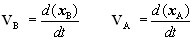
This can be expressed in terms of the derivative of the displacement with respect to time.

Two dimensional relative position & velocity
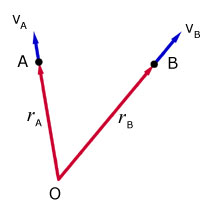
Particle A has a displacement rA from O, and a velocity VA along the x-axis.
The displacement rA is a function of time t .
Particle A has a displacement rB from O, and a velocity VB along the x-axis.
The displacement rB is also a function of time t.
Relative position

The position of B relative to A at time t is given by the position vector from O, rB-A .
The position vector rB-A can be written as,
BrA = rB- rA
Relative velocity
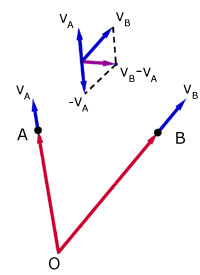
Similarly, at time t the velocity vector VB relative to velocity vector VA can be written,
BVA = VB - VA
This can be expressed in terms of the derivative of the displacement with respect to time.

Example #1
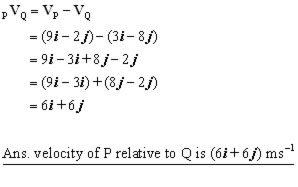
If the velocity of a particle P is (9i - 2j) ms-1 and the velocity of another particle Q is
(3i - 8j) ms-1 , what is the velocity of particle P relative to Q?
Example #2
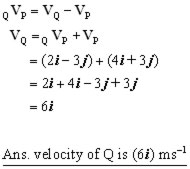
A particle P has a velocity (4i + 3j) ms-1. If a second particle Q has a relative velocity to P of (2i - 3j), what is the velocity of Q?
Example #3
A radar station at O tracks two ships P & Q at 0900hours (t=0) .
P has position vector (4i + 3j) km, with velocity vector (3i - j) km hr -1.
Q has position vector (8i + j) km, with velocity vector (2i + 2j) km hr -1.
i) What is the displacement of P relative to Q at 0900 hours? (ie distance between ships). Answer to 2 d.p.
ii) Write an expression for the displacement of P relative to Q in terms of time t .
iii) Hence calculate the displacement of P relative to Q at 1500 hours.
iv) At what time are the two ships closest approach and what is the distance between them at this time?
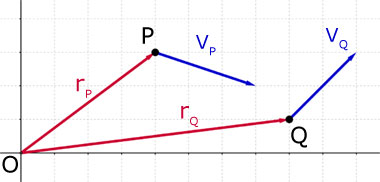
i)

ii)
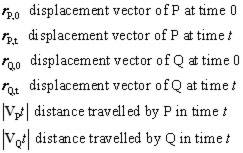
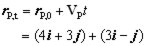
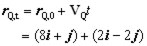
therefore the displacement of P relative to Q is given by,
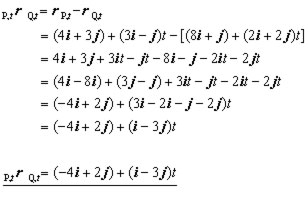
iii) using the result above for 1500 hours( t = 6 )

iv) Closest approach is when the position vector of P is at right angles to the reference vector.
The 'reference vector' is the first part of the vector equation for r .
The position vector gives the point P at time t along the straight line described by the vector equation.
(solution to follow)
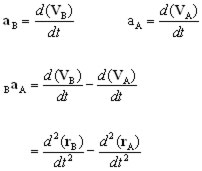
Two dimensional relative acceleration
Similarly, if aA and aB are the acceleration vectors at A and B at time t,
then the acceleration of B relative to A is given by,
this week's promoted video
[ About ] [ FAQ ] [ Links ] [ Terms & Conditions ] [ Privacy ] [ Site Map ] [ Contact ]