
Home >> PURE MATHS, Algebra, the binomial theorem
Pascal's Triangle |
Introduction
This section of work is to do with the expansion of (a+b)n and (1+x)n .
Pascal's Triangle and the Binomial Theorem give us a way of expressing the expansion as a sum of ordered terms.
Pascal's Triangle
This is a method of predicting the coefficients of the binomial series.
Coefficients are the constants(1, 2, 3, 4, 5, 6 etc.) that multiply each variable, or group of variables.
Consider (a+b)n variables a, b .

The 1st. line represents the coefficients for n=0.
(a+b)0= 1
The 2nd, line represents the coefficients for n=1.
(a+b)1= a + b
The 3rd. line represents the coefficients for n=2.
(a+b)2= a2 + 2ab + b2
Hence for the 6th. line . . .
The 6th. line represents the coefficients for n=5.
(a+b)5 = a5 + 5a4b + 10a3b2 + 10a2b3 + 5ab4 + b5
The Binomial Theorem builds on Pascal's Triangle in practical terms, since writing out triangles of numbers has its limits.
The General Binomial Expansion ( n ≥ 1 )
This is a way of finding all the terms of the series, the coefficients and the powers of the variables.
The coefficients, represented by nCr , are calculated using probability theory.
For a deeper understanding you may wish to look at where nCr comes from; but for now you must accept that:

where,
'n' is the power/index of the original expression
'r' is the number order of the term minus one
If n is a positive integer, then:

Example #1
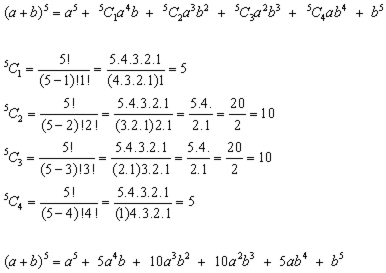
Example #2
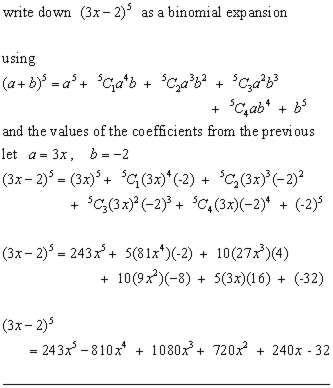
It is suggested that the reader try making similar questions, working through the calculations and checking the answer here (max. value of n=8)
The Particular Binomial Expansion
This is for (1+x)n ,
where,
n can take any value (positive or negative)
x is a fraction in the range -1 < x < 1

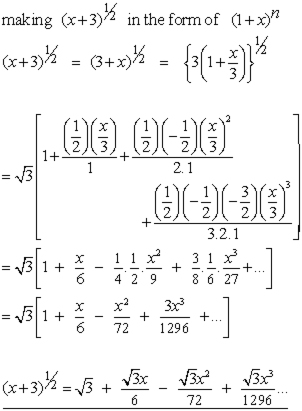
Example
Find the first 4 terms of the expression (x+3)1/2 .
this week's promoted video
[ About ] [ FAQ ] [ Links ] [ Terms & Conditions ] [ Privacy ] [ Site Map ] [ Contact ]