
Home >> PURE MATHS, Algebra, polynomials
first principles |
Introduction
A polynomial is an expression which:
| 1. | Consists of a sum of a finite number of terms. |
| 2. | Has terms of the form kxn . |
(where x a is variable, k is a constant and n a positive integer)
Every polynomial in one variable (eg 'x') is equivalent to a polynomial with the form:

Polynomials are often described by their degree of order.
This is the highest index of the variable in the expression.
(eg: containing x5 order 5, containing x7 order 7 etc.)
These are NOT polynomials:
3x2+x1/2+x
The second term has an index which is not an integer(whole number).
5x-2+2x-3+x-5
Indices of the variable contain integers which are not positive.
examples of polynomials:
x5+5x2+2x+3
(x7+4x2)(3x-2)
x+2x2-5x3+x4-2x5+7x6
Algebraic Long Division
If,
f(x) the numerator and d(x) the denominator are polynomials
and
the degree of d(x) <= the degree of f(x)
and
d(x) does not = 0
then,
two unique polynomials q(x) the quotient and r(x) the remainder exist.
So that:
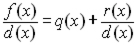
Note - The degree of r(x) < the degree of d(x).
We say that d(x) divides evenly into f(x), when r(x)=0.
Example
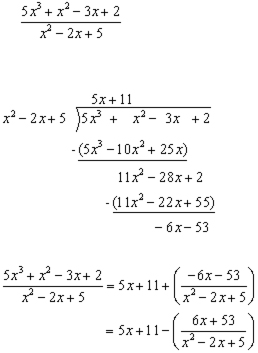
The Remainder Theorem
If a polynomial f(x) is divided by (x-a), the remainder is f(a).
Example
Find the remainder when (2x3+3x+x) is divided by (x+4).
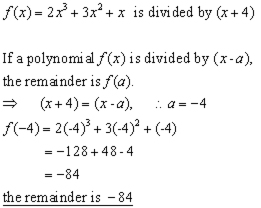
The reader may wish to verify this answer by using algebraic division.
The Factor Theorem (a special case of the Remainder Theorem)
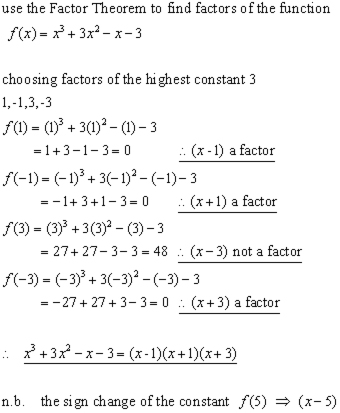
(x−a) is a factor of the polynomial f(x) if f(a) = 0
[ About ] [ FAQ ] [ Links ] [ Terms & Conditions ] [ Privacy ] [ Site Map ] [ Contact ]