
Home >> PURE MATHS, Differential Calculus, exponentials, logarithms
exponential ex |
Exponential Functions
Strictly speaking all functions where the variable is in the index are called exponentials.
The Exponential function e x
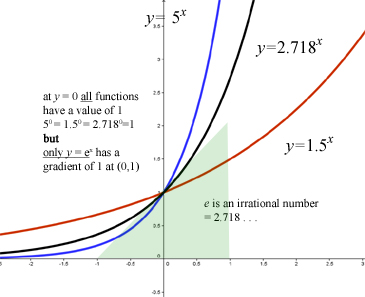
This is the one particular exponential function where 'e' is approximately 2.71828 and the gradient of y = e x at (0,1) is 1.
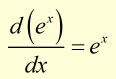
One other special quality of y = e x is that its derivative is also equal to e x,
and for problems of the type y = e kx :
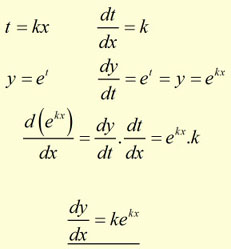
Derivative problems like the above concerning 'e' are commonly solved using the Chain Rule.
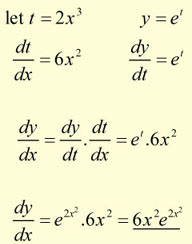
Example #1
Find the derivative of: 
Example #2
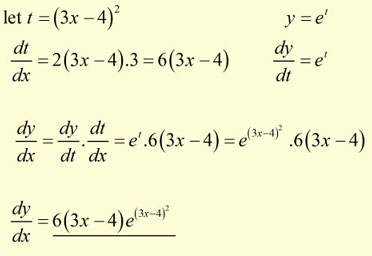
Find the derivative of: 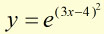
Derivative of a Natural Logarithm Function
Remember y = log e x means:
x is the number produced when e is raised to the power of y
The connection between y = e x and y = log e x can be shown by rearranging y = log e x.
y = log e x can be written as x = e y
(log e x is now more commonly written as ln(x) )
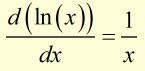
The derivative of ln(x) is given by:
Example #1
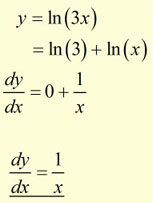
Find the derivative of y = ln(3x).
Example #2
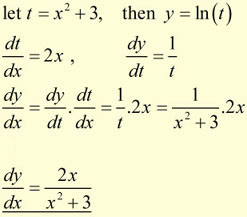
Find the derivative of y = ln(x3+3).
Problems of the type y = N f(x)
Problems of this type are solved by taking logs on both sides and/or using the Chain Rule.
Example #1
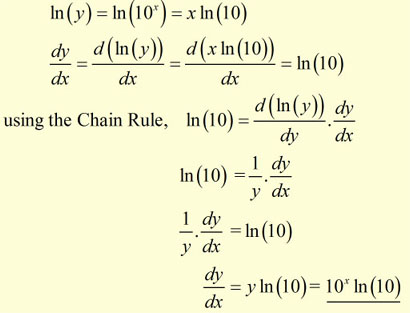
Find the derivative of y = 10 x.
Example #2
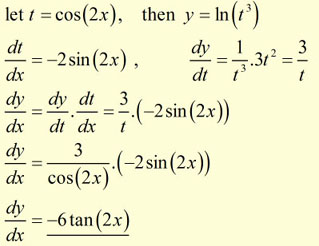
Find the derivative of y = ln(cos32x).
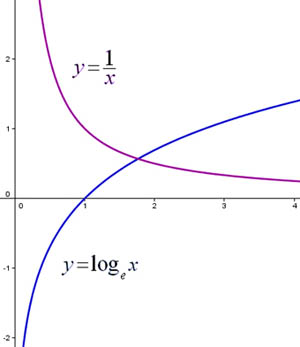
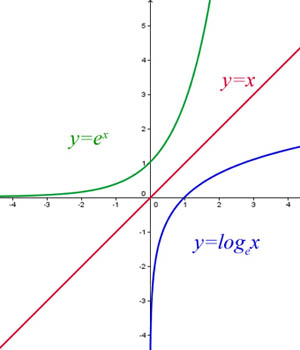
A Graphical Comparison of Exponential and Log Functions
As you can see, y = e x is reflected in the line y = x to produce the curve y = ln(x).
[ About ] [ FAQ ] [ Links ] [ Terms & Conditions ] [ Privacy ] [ Site Map ] [ Contact ]