
Home >> PURE MATHS, Algebra, surds
| useful expressions | rationalising | reduction | diff. two squares | rational, irrational |
Rules
Surds are mathematical expressions containing square roots.
However, it must be emphasized that the square roots are 'irrational'
i.e. they do not result in a whole number, a terminating decimal or a recurring decimal.
The rules governing surds are taken from the Laws of Indices.
Rule #1
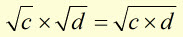
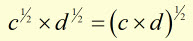
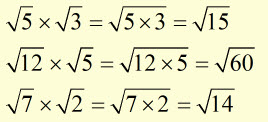
Examples
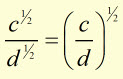
Rule #2
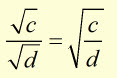
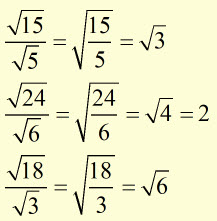
Examples
Some Useful Expressions
Expression #1


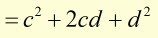


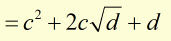
example
simplify 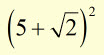


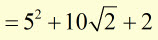
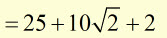
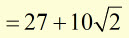
ans. 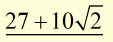
Expression #2 - (the difference of two squares)
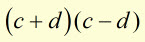

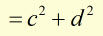
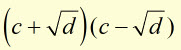


example
evaluate 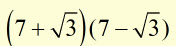



ans. 
Rationalising Surds
This is a way of modifying surd expressions so that the square root is in the numerator of a fraction and not in the denominator.
The method is to multiply the top and bottom of the fraction by the square root.
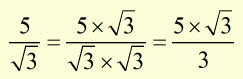
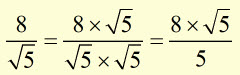
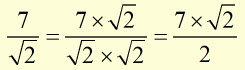
Rationalising expressions using 'Difference of Two Squares'
Remembering that :

.....from 'useful expressions' above.
Example #1 - simplify 
Multiplying top and bottom by 
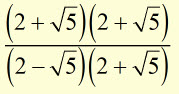
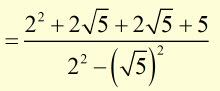
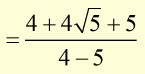
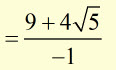
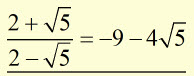
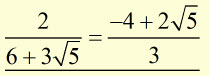
Example #2 - rationalise 
Multiply top and bottom by 
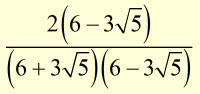
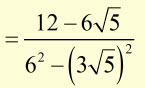
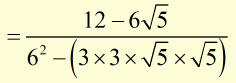


Reduction of Surds
This is a way of making the square root smaller by examining its squared factors and removing them.



Rational and Irrational Numbers
Test for rational and irrational numbers:
If a surd has a square root in the numerator, while the denominator is '1' or some other
number, then the number represented by the expression is 'irrational'.
examples of irrational surds:


[ About ] [ FAQ ] [ Links ] [ Terms & Conditions ] [ Privacy ] [ Site Map ] [ Contact ]